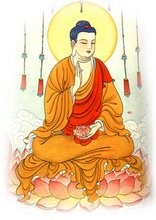
At that time the wisdom-destined Subhuti, Maha-Katyayana, Maha-Kasyapa, and Maha-Maudgalyayana, hearing from the Buddha the unprecedented Dharma and the prediction by the World-honoured One of Sariputra's future destiny of Anuttarasamyaksambodhi, were struck with wonder and ecstatic with joy.
Thereupon they rose from their seats, and, arranging their garments, humbly baring their right shoulders, placing their right knees on the ground, with one mind folding their palms, bending their bodies in reverence, and gazing upon his honoured face, spoke to the Buddha, “O, World-honoured One! Before this, we, considered ourselves having attained nirvana, being the head of the sangha and advanced in years, and that there is nothing more we are able to undertake, made no effort to seek Anuttarasamyaksambodhi. The World-honoured One for a long time has been preaching the Dharma, praising the Mahayana and we all the time seated in our places. We have become weary in our bodies and neglectful, only thinking of the void, of the formless, and of nonfunction, but in regard to the bodhisattva-dharmas, their supernatural displays, the purifying of the Buddha-lands, and the perfecting of all living beings, our hearts have not taken delight. Wherefore? The World-honoured One had caused us to escape the Triple Realm and to obtain proof to nirvana. What for to seek more? Furthermore, we are now very old. With the Anuttarasamyaksambodhi, for which the Buddha instructs the bodhisattvas, we have not conceived a single fond thought of joy. Now we, in the presence of the Buddha, hearing that sravakas are predicted to attain Anuttarasamyaksambodhi, are extremely glad in our minds and have obtained what we have never experienced before. Unexpectedly we now of a sudden heard this rare Dharma. Profoundly do we congratulate ourselves on having acquired so great and good a gain, like a poor man obtaining an inestimable jewel, without the seeking. O, World-honoured One! Now let us have the pleasure of speaking in a parable to make plain this meaning.
“Suppose there is a man of a rich family who is young in years and who, forsaking his father and running off, dwells long in another country, whether ten, or twenty, or as much as fifty years. Not only does he grow old, is also reduced to destitution, running about in all four directions in quest of food and clothing. At length, in his wanderings, he accidentally heads toward the country where his father stays. His father, who has preceded him, and who has sought his son without finding him, has stopped midway in a certain city. The father's house is great and rich, with treasure and jewels immeasurable, gold and silver, lapis lazuli and coral, amber and sphatika and other jewels. His treasure houses are all filled to overflowing. He has many servants, assistants, vassals, elephants and horses, carriages and chariots, oxen and sheep without number. The profits that flow in and out would spread to other countries and also merchants and itinerant traders are very numerous.
“At that time, the poor son, having visited various settlements and passed through kingdoms and metropolises, at length reaches the city where his father is staying. The father is always thinking of his son, for it has already been more than fifty years since he has parted with him. Yet, without ever mentioning such matters to others, he merely thinks to himself, his heart harbouring regret and resentment. He knows that he is old and decrepit, that he is wealthy and has a lot of gold, silver and many precious gems, with which his treasure houses are filled to overflowing; but he has no son. One day he will die, and his riches shall be scattered, for he will have no one to whom to bequeath them. He feels very pitiful. For this reason he is earnestly and constantly recalling his son. Again, he thinks, ‘If I should get a son to whom to bequeath my riches, I should be calmly happy, and have no further cares.’
“At that time, the poor son, hiring himself out as a labourer in his wanderings, by chance reaches his father's house. Stopping by the side of the gate, he sees in the distance his father seated on a lion seat and his feet resting on a jewelled footstool; Brahmans, Ksatriyas, and householders are all deferentially surrounding him; his body adorned with pearl necklaces valued in the thousands of myriads; attended on his left and right by vassals and servants holding white feather dusters in their hands; covered by a jewelled canopy, from which flowered banners are hanging down; the ground around him sprinkled with scented water and strewn with many outstanding flowers; with rows of precious objects that are given and received - having, in short, various adornments of this sort, whereby he appears most majestic and distinguished. As soon as the poor son sees his father with this great power, straightaway, harbouring great fear, he regrets having come to that place, and privately thinks, ‘This is either a king or the equal of a king. But, at any rate, this is no place for me to hire my labour and earn anything. The best thing for me to do is to go to a poor village, where there will be room for me to use my strength to the fullest and where food and clothing will be easy to obtain. If I stay long in this place, I may be forced to work.’
“When he has had this thought, he quickly runs off. At that time, the wealthy elder, from his lion seat seeing his son, instantly recognises him and, greatly pleased at heart, straightaway thinks, ‘My treasures and treasure houses now have someone to whom they can be bequeathed! I have been thinking of this son but had no way of seeing him. Then, quite suddenly, he came of his own, fulfilling my wishes. Though I am decrepit and aged, still I am yearning.’
“Straightaway, he dispatches an attendant to follow the young man and bring him back. The messenger, running quickly, goes and overtakes him. The poor son is alarmed, and cries out resentfully, ‘I have committed no offence! Why have I been seized?’ The messenger, grasping him all the more firmly, forces him to return with him. At that time, the poor son thinks to himself, ‘I am guiltless and yet have been seized. This surely means that I must die!’ All the more terrified, and helpless with agony, he falls to earth. Seeing this from afar, the father says to the messenger, ‘I do not want this man. Do not force him to come with you! Sprinkle him with cool water, bring him to consciousness but speak to him no more.’ Wherefore? The father knows that his son's ambitions are mean, and he knows that he himself, being rich and powerful, will be a source of trouble to his son. He knows perfectly well that this is his son, but for reasons of expediency he does not tell others that ‘This is my son’.
“The messenger says to the son, ‘I am now letting you go wherever you wish!’ The poor son rejoices, having gained something he has never had before. Rising from the ground, he goes to a poor village, there to seek food and clothing.
“At that time, the elder, wishing to entice his son, devises an expedient. He secretly dispatches two men, whose appearance is miserable and who have no dignity of bearing, saying to them, ‘You may find him and say gently to that poor fellow, “There is a work place here, where you will be given double wages.” If the poor fellow agrees, bring him along and put him to work. If he asks what you wish him to do, then you may say to him, “You are being hired to sweep away dung. We two shall also work with you.”’ At that time, the two messengers seek out the poor son directly. When they have found him, they tell him the above in detail. The poor son takes his pay and sweeps the dung with them. The father, seeing his son, is struck by both pity and amazement.
“Then, on another day, through a window he sees the figure of his son, weak and emaciated, wasted away, grimy and soiled with dung, dirt, and dust. He wishes to get near to his son and straightaway he removes his necklaces, his fine outer garments, and his ornaments, and puts on instead a rough, torn, dirty, tar-stained garment and, smearing dust over his body, takes in his right hand a dung-shovel. Now frightful in appearance, he addresses his workmen in front of his son, ‘Get on with your work. Don’t be lazy!’ By this means, he contrives to approach his son. Then after a few days, he addresses him, saying, ‘Ah, my man! Work here always, and do not go anywhere else! I have increased your wages. Whatever you need, whether pots or vessels, rice or flour, salt or vinegar, or that sort of thing, do not trouble yourself about it. There is an old and worn-out servant whom you shall be given if you need him. Be at ease in your mind. No need to worry. Wherefore? I am like your father. I am old, my years are great, while you are young and vigorous. Whenever you work, you are never guilty of lying or cheating, of idling, of anger or resentment, or of hateful words. I have never seen you guilty of these evils. From now on you shall be like my own son!’
“Straightaway the elder gives him a new name and calls him his son. The poor son, though delighted by this treatment, continues as before to call himself a lowly workman from elsewhere. For this reason, for twenty years he has been at work clearing away dung. At the end, he has complete confidence in himself, and comes and goes without anxiety. Yet he is lodged in the same place as before.
“O, World-honoured One! At that time, the elder is taken ill, and he knows that he is to die before long. He addresses his poor son, saying, ‘I now have much gold and silver and many precious jewels, with which my treasure houses are filled to overflowing. You are to find out whether there is much or little in those houses, what is to be taken in, what to be given out. Such are my thoughts, and you are to understand my meaning. Wherefore? It is that you and I are now to be no different. You are to exercise care and to let nothing get lost.’
“At that time, the poor son, straightaway receiving his instructions, takes charge of the multitude of things, the gold and silver, the precious jewels and the several treasure houses. Yet he has no craving for so much as a single meal, but continues to live as before in the same place, still unable to put off his lowly thoughts.
“Then, after some time, the father knows that his son has at length become more at ease, that, having achieved a great ambition, he is ashamed of his former state of mind. When facing his end, the old man gathers his kinsmen, as well as kings, great ministers, Ksatriyas, and householders, who are all to gather together. Then he proclaims to them, ‘Sirs! Know that this is my son, begotten by me. Having forsaken me in such-and-such a city and run off, he suffered loneliness and hardship for more than fifty years. His original name was so-and-so. My own name is thus-and-so. Formerly, in my native city, affected by grief, I sought him, but to no avail. Suddenly I encountered him here by accident and got him back. He is really my son. I am really his father. Now all the treasure I have belongs to my son. What was formerly paid out and taken in, my son knows it all.’
“At this time, the poor son, hearing his father's words, straightaway rejoices greatly, having gained something he has never had before. Then he thinks, ‘Formerly I had no thought of seeking or expecting anything, and now these treasure houses have come to me of themselves!’
“O, World-honoured One! The great wealthy elder is the Tathagata. We are all like the Buddha's sons. The Tathagata always tells us that we are his sons. O, World-honoured One! By reason of the three kinds of woe, in the midst of birth and death we suffered various annoyances. Erring and ignorant, we clung in desire to lesser dharmas. Now the World-honoured One by the power of expedient devices, caused us to take thought and to clear away the dung of frivolous assertions concerning the dharmas. In the course of this, we, striving all the more earnestly, contrived to arrive at nirvana. Having earned one day's wages, we rejoiced greatly at heart, imagining this to be enough. Then we said to ourselves that in the Buddha-dharma, thanks to our increased efforts, what we had gained was broad and plentiful. Yet the World-honoured One, knowing beforehand that our thoughts were addicted to base cravings and that we desired lesser dharmas, made a show of permissiveness, and did not specify to us. We should have a portion in the treasure house of the Tathagata's wisdom and insight! The World-honoured One by resort to the power of expedient devices preached to the great bodhisattvas the wisdom of the Tathagata. We, having attained from the Buddha the nirvana, imagined that we had gained a great thing, and had no ambitions with regard to this Mahayana. We, for the sake of the Tathagata's wisdom, preached it to bodhisattvas, but we ourselves had no expectations regarding it. Wherefore? The Buddha, knowing that in our thoughts we craved the lesser dharmas, by resort to the expedient power he helped us to preach the dharma. We did not know that we are truly bodhisattvas. Now, at last, we know that with regard to Buddha's wisdom, the World-honoured One is unstinting. Wherefore? From of old we have been truly bodhisatvas. Because we have craved only lesser dharmas, the Buddha did not preach to us. If we had had a craving for the greater, then the Buddha would have preached for us the Dharma of the Mahayana. In this sermon he preaches only the Ekayana. Also, in former times, in the presence of bodhisattvas, he maligned the sravakas who craved the lesser dharmas. Yet the Buddha teaches and converts us by recourse to Mahayana. This is why we say that, whereas formerly we had no thought of seeking or expecting anything, now the great jewel of the Dharma King has come to us of its own accord. What the bodhisattvas should gain, that we have already gained.
“We on this day
Have heard the Buddha's voice and teaching
And are ecstatic with joy at
Having obtained the unprecedented.
The Buddha declares that sravakas
Will become Buddhas;
Peerless collection of treasures
Have received without seeking.
It is like a youth,
Immature and ignorant,
Who leaves his father and runs away
To other lands far distant,
Wandering about in many countries
For over fifty years.
His father, with anxious care,
Searches in four directions.
Wearied with his search,
He abides in a certain city.
Where he builds a house,
Enjoying the pleasures of the five desires
Very rich is his house,
With abundance of gold and silver,
Moonstones and agates,
Pearls and lapis lazuli,
Elephants, horses, oxen, and sheep,
Palanquins, litters, carriages,
Servants, slaves,
And a multitude of people;
His revenues and investments
Spread even to other countries;
His merchants and traders
Are found everywhere;
A thousand myriad kotis of people
Surround and honour him;
Constantly by the king
He is held in affection;
All the ministers and noble families
Honour him highly;
For all these reasons
His guests are many;
Such are the abundance of his wealth
And the greatness of his power.
But his years are wearing away
And he grieves the more over his son;
Morning and night he ponders:
‘The time of my death is approaching;
My foolish son has left me
For over fifty years;
These things in my storehouses -
What shall I do?’
At that time the poor son
Seeks food and clothing
From city to city,
From country to country,
Sometimes getting something,
Sometimes nothing;
Famished, weak, and gaunt,
Covered with scabs and sores,
Gradually he passes along
To the city where his father dwells.
Hired for wages he roams about,
At last reaching his father's house.
At that very hour the elder
Within his gates
Has set up a great jewelled curtain
And sits on a lion seat
Surrounded by his attendants,
Everybody taking care of him.
Some are counting
Gold, silver, and precious things,
Giving or receiving properties
Noting and recording bonds.
The poor son, seeing his father
So noble and splendid,
Thinks: ‘This must be a king
Or one of royal rank.’
Alarmed and wondering:
‘Why have I come here?’
Again he thinks to himself:
‘If I tarry long,
I may suffer oppression
And be driven to forced labour.’
Having pondered thus,
He runs off in haste
In search of some poor place,
That he may go and hire his labour.
At that time the elder
On his lion seat,
Seeing his son from afar,
Secretly recognises him
And instantly orders servants
To pursue and fetch him back.
The poor son cries in alarm,
Faints away, and falls on the ground:
‘These men have caught me;
I shall certainly be killed.
Why, for food and clothing,
Did I come here?’
The elder, knowing that his son,
Being foolish and inferior,
Will not believe in his word,
Nor believe that he is his father.
With tactful method
Again dispatches other men,
One-eyed, small in size and ugly
And unimposing.
‘You can tell him,
Saying: “You will be hired along with us
To remove dung and dirt
And you shall be given double wages.”’
The poor son hearing this
Is glad, and comes with them,
For the purpose of removing dung and dirt
And cleaning houses and rooms.
The elder, through a lattice,
Always sees his son,
And thinks of him as foolish
And pleased with humble things.
Then the elder,
Donning a tattered dirty garment,
Takes a dirt hod,
Goes to where his son is,
And by this expedient device gets near him,
Bidding him to be diligent.
On one other day
Seeing his son and says:
‘I have increased your wages,
Giving you oil for your feet,
And plenty of food and drink,
And thick warm mats.
No need to go far away
To seek for food and clothing.’
Then with sharp words he thus chides:
‘Get on with your work.’
Again he speaks gently:
‘You are as if you were my son.’
The elder, being wise,
Gradually causes him to go in and out,
And after twenty years
Employs him in house affairs,
Showing him gold and silver,
Pearls and crystal,
And the incoming and outgoing of things;
All these he makes him know.
Still he dwells outside
Lodging in a hovel,
For himself thinking of penurious things,
‘These things are not mine.’
The father, knowing his son's mind
Has gradually developed,
And wishing to give him his wealth,
Gathers together his relatives,
King and ministers,
Kshatriyas and householders.
In this great assembly,
He announces, ‘This is my son,
Who left me and went elsewhere
For fifty years;
Since I saw my son arrive,
Twenty years have passed.
Long ago in a certain city
I lost this son;
In wandering round in search of him,
At last I arrived here.
All that I have,
Houses and people,
I entirely give to him;
He is free to use them as he will.’
The son thinks of his former poverty
And inferior disposition,
Anew from his father
Obtains such great treasures,
Together with houses and buildings
And all this wealth,
Rejoices greatly
On receiving such unexpected.
So is it with the Buddha;
Knowing that we are pleased with trifles,
He did not before proclaim,
‘You will become Buddhas,’
But said that we
Who were attaining faultlessness
And perfect in Hinayana
Were his sravaka disciples.
The Buddha commanded us,
Preach the highest Path,
‘That those who practise it
Will become Buddhas.’
We, receiving the Buddha's teaching,
For the sake of great bodhisattvas,
By numerous causes and conditions
By various parables,
And by so many expressions,
Preached the Supreme Path.
The Buddha-sons,
Hearing the Dharma from us,
Day and night ponder over
And with unflagging zeal practise it.
Then the Buddha
Predicts of them:
‘You, in a future incarnation,
Shall become Buddhas.’
Of all the Buddhas'
Mystic Dharma
Only to bodhisattvas
Expound in full reality,
But not to us
Was this truth preached.
Just as that poor son
Who came to be near to his father,
Though he knows all the things,
But he owns none of them.
Though we proclaimed
The treasury of the Buddha-dharma,
Yet had no will or wish for it,
Being also like him.
We, with the inside extinction
Considered ourselves satisfied;
Having thus settled this matter,
Nothing more remained to be done.
Even if we had heard
Of the purification of Buddha-lands
And the conversion of living beings,
We would never have rejoiced.
Wherefore?
All dharmas
Were altogether void,
Without birth, without extinction,
Nothing large, nothing small,
Without fault, without effort.
Pure Lands and Bodhi
Are also void.
Thinking thus,
With no conception of joy.
We, for long night,
To the Buddha-wisdom,
Neither coveted nor were attached
Nor had we any will or wish.
But we, with regard to the Dharma
Considered we had reached finality.
We, for a long night
Practising the Dharma of the Void,
Obtained release from the Triple Realm's
Distressing troubles,
Dwelling in the final bodily state
Of nirvana with remains.
Being instructed by the Buddha,
We had, without a doubt, attained the Path
And that we had therefore
Repaid the Buddha's grace.
Though we, for the sake
Of all Buddha-sons,
Had preached the Bodhisattva-dharma,
That they should seek the Buddha Path,
Yet we, in regard to this Dharma
Had never any wish or pleasure.
Our Leader saw and let us alone,
Because he looked into our minds;
At first he did not stir up our zeal
By telling the true gain.
Just as the rich elder,
Knowing his son's inferior disposition,
By his tactfulness
Subdues his mind,
And afterward gives him
All his wealth,
So is it with the Buddha
In his display of rarities.
Knowing those who delight in trifles,
And by his tactfulness
Subduing their minds,
He instructs them in the great wisdom
To take vow in Ekayana,
The Supreme Path.
Today we have obtained
What we have never had before;
What we have not previously looked for
Now we have unexpectedly obtained,
Just as that poor son
Obtained inestimable treasures.
O, World-honoured One! Now we
Have obtained the Path and obtained the Fruit,
But not the real gain.
If, in the faultless Dharma
Attained to pure eyes,
It is then the real gain.
We for long night
Having kept the Buddha's pure commands,
Today for the first time
Obtain their fruit and reward.
In the Dharma of the Dhama-king,
Having long practised Brahman-conducts,
Now we have attained to the faultless,
Peerless great fruit;
Now we are
Real sravakas
With the sound of the Buddha Path,
Cause all beings to hear.
Now we are
Real arhats,
Who, in all the worlds
Of gods, men, Maras, and Brahmas,
Universally by them
Are worthy of worship.
The World-honoured One, in his great grace,
By things which are rare
Has compassion for and instructs
And benefits us;
Through countless kotis of kalpas,
Who could repay him?
Service by hands and feet,
Homage with the head,
All kinds of offerings,
Are all unable to repay him.
If one bore on one's head,
Or carried on one's shoulders
Through kalpas as the sand of the Ganges;
Is unable to repay him;
Or with the best of food,
Or countless jewelled garments
And all kinds of bedding,
Or every sort of medicament;
Or with ox-head sandalwood
And all kinds of jewels
Erected stupas and monasteries;
Or carpeted the ground with precious garments;
With such things as these
As offerings
Through kalpas as the sand of the Ganges,
Yet one would be unable to repay.
The World-honoured One is rare
With infinite and boundless,
Inconceivably
Great transcendental powers;
He is faultless and effortless,
The King of the Dharmas
Who is able to, for the inferior,
Patiently endure these things,
And for common folk attached to externals
To preach as is befitting.
The World-honoured One in the Dharma
Attains to supreme power.
Knowing all living beings,
With their various desires and pleasures,
And their power of mind.
According to their capacities,
By innumerable parables,
He preaches the Dharma to them.
According to the living beings'
Wholesome roots of past lives,
Also knowing who is mature
And who immature,
When, as a result of varied weighing and measuring,
He knows with discrimination,
Then, concealing the Path of Ekayana
As appropriate, he preaches the three.”
Saturday, July 21, 2007
Chapter 5 : The Parable of the Medicinal Herbs
At that time, the World-honoured One proclaimed to Mahakasyapa and the great disciples, Excellent, Excellent, Kasyapa! You have well stated the Tathagata's real merits. Truly they are as you have said. The Tathagata also has incalculable, limitless asamkhyeyas of merit of expedient devices. If you were to speak of them for incalculable millions of kalpas, you could not fully express. Kasyapa, know that the Tathagata is the King of the Dharmas. Whatever he preaches is wholly free from falsity. He sets forth all Dharmas by resort to wisdom and expedient devices. Without exception, the Dharmas he preaches all reach the ground of All-wisdom. The Tathagata sees and knows where all Dharmas tend. He also knows what all living beings in their inmost hearts are doing, penetrating them without obstruction. Moreover, with regard to all Dharmas, having the utmost understanding of them, he reveals to all living beings all the wisdom.
O, Kasyapa! Suppose, in the three-thousand-great-thousandfold world there are, growing on the mountains, along the rivers and streams, in the valleys and on the land, plants, trees, thickets, forests, and medicinal herbs of various and numerous kinds, with names and colours all different. A dense cloud, spreading over everywhere covering the whole three-thousand-great-thousandfold world, pours down its rain equally at the same time. Its moisture universally fertilises the plants, trees, thickets, forests, and medicinal herbs, with their tiny roots, tiny stalks, tiny twigs, tiny leaves, their medium roots, medium stalks, medium twigs, medium leaves, their big roots, big stalks, big twigs, and big leaves; every tree big or small, according to its superior, middle, or lower capacity, receives its share. From the rain of the one cloud each according to the nature of its kind acquires its development, blooming its blossoms and bearing its fruit. Though produced in one soil and moistened by the same rain, yet these plants and trees are all different.
“Know, Kasyapa! The Tathagata is also like this; he appears in the world like the rising of that great cloud. Universally he extends his great call over the world with its gods, men, and asuras. In the great assembly he proclaims these words, ‘I am the Tathagata, the Worshipful, the Right and Universal Wise, the Perfectly Enlightened in Conduct, the Well Departed, the Understander of the World, the Unexcelled Worthy, the Controller and Teacher of Gods and Men, the Buddha, the World-honoured One. Those who have not yet been saved I cause to be saved; those who have not yet been set free to be set free; those who have not yet been comforted to be comforted; those who have not yet obtained nirvana to obtain nirvana. I know the present world and the world to come as they really are. I am the All Knowing, the All Seeing, the Knower of the Path, the Opener of the Path, the Preacher of the Path. Come to me, all you gods, men, and asuras, to hear the Dharma!’ At that moment numberless thousand myriad kotis of classes of living beings came to the Buddha to hear the Dharma. Thereupon the Tathagata, observing the capacity of all these living beings, keen or dull, zealous or indifferent, according to their capacity discriminated and preached to them the Dharma in varying sounds at a time, various and infinite, causing them all to rejoice and speedily obtain much profit. All these living beings, having heard this Dharma, comforted in the present life and afterward born in happy states, also made joyful by the Dharma and also hear the Dharma. Having heard the Dharma, they are freed from hindrances, and according to their capacity in all the Dharmas, they gradually enter the true Buddha Path.
“Just as that great cloud, raining on all the plants, trees, thickets, forests, and medicinal herbs, and according to the nature of their seed perfectly fertilising them so that each grows and develops, so the Dharma preached by the Tathagata is of one form and flavour, that is to say, deliverance, abandonment, extinction, and finally the attainment of the Wisdom of All Modes. If there are living beings who hear the Dharma of the Tathagata and practise it as preached, the merit they gain thereby shall be unknown and unnoticed even by themselves. Wherefore? Only the Tathagata who knows the living beings' seeds, forms, embodiments and natures of the past and present, what things they are reflecting over, what things they are thinking, what things practising, how reflecting, how thinking, how practising, by what dharmas reflecting, by what dharmas thinking, by what dharmas practising, and by what dharmas attaining to what dharmas. The living beings dwell in a variety of stages, only the Tathagata sees them for what they are and understands them clearly and without obstruction. Just as those plants, trees, thickets, forests, medicinal herbs, and others do not know their own natures; superior, middle, or inferior. The Tathagata knows this. He then saves them by the Dharma of one form and one flavour, that is to say, deliverance, abandonment, extinction, final nirvana of eternal tranquillity, ending in return to the void. The Buddha, knowing this and observing the dispositions of all living beings, supports and protects them. For this reason he does not immediately declare to them Eka Buddha Yana and the Wisdom of All Modes. All of you, O, Kasyapa! A most rare thing it is that you should be able to understand that the Dharma preached by the Tathagata in accord with what is peculiarly appropriate is for the sake of Anuttarasamyaksambodhi, be able to believe and able to receive. Wherefore? The Dharma preached by the Buddhas, the World-honoured Ones, in accord with what is peculiarly appropriate, the purport is difficult to discern and difficult to know.
“I am the Dharma King,
Appear in this world;
According to the desires of all living beings,
Preach the Dharma in various ways.
The Tathagata is greatly to be honoured,
And profound in wisdom;
For long has he kept secret this essential matter,
Not endeavouring hastily to declare it.
The wise, if they hear it,
Are able to believe and discern;
The ignorant doubt and not reverent
Losing it perpetually.
Therefore, Kasyapa,
According to their powers I preach to them
With varied means
To bring them to right views.
Know, Kasyapa!
It is like a great cloud
Rising above the great-thousand,
Covering all things everywhere,
A beneficent cloud full of moisture;
Flashes of lightning shine and glint,
The sound of thunder vibrates afar,
Bringing gladness and ease to all.
The sun's rays are veiled,
And the earth is cooled;
The cloud lowers and spreads
As if it might be caught and gathered;
Its rain everywhere equally
Descends on four directions,
Streaming and pouring without stint,
Enriching all the land.
On mountains, by rivers, in steep valleys,
In hidden recessed, there grow
The plants, trees, and herbs;
Trees, big or small,
The shoots of all the ripening grain,
Sugar cane and grapevine,
Moistured by the rain
Do not fail to prosper;
The dry ground is all soaked,
And herbs and trees flourish together.
From the product of that cloud
Water of a single flavour
Plants, trees, thickets, forests,
Each in due portion, receive moisture.
All the trees,
Superior, middle, inferior and others,
Each according to its size,
Grow and develop.
Roots, stalks, branches, and leaves,
Blossoms and fruits in their brilliant colours;
By the pouring of the one rain,
All become fresh and glossy.
Just as their bodies, forms,
Natures are divided into great and small,
So the enriching rain though one and the same,
Yet makes each flourish.
In the same manner the Buddha also
Appears in the world,
Like a great cloud
Universally covering all;
And having appeared in the world,
He, for the sake of all living beings,
Discriminates and proclaims
The benefit of all the Dharmas.
The great holy World-honoured One
Among the gods and men
And all the other multitudes
Proclaim this, saying:
‘I am the Tathagata,
The most honoured Dual Abundant One,
Appear in the world
Just like a great cloud,
To pour enrichment on all
Parched living beings,
To free them all from suffering
And so attain the joy of peace,
Joy in the world,
And the joy of nirvana.
Gods, men, and all!
With all your mind listen to me.
Come all of you here
And behold the peerless Honoured One.
I am the World-honoured One,
Who cannot be equalled.
To give peace to all living beings
I appear in the world,
And for the multitudes
Preach the Dharma, pure as sweet dew;
The Dharma of one flavour,
Of emancipation and nirvana.’
With various mystic sounds
I proclaim various meanings,
Constantly for the sake of Ekayana
Being the assisting causes and conditions.
I look upon all
Everywhere are all equal
Without distinction of persons,
Or mind of love or hate.
I have no greed or attachment
Nor have I any limitations or encumbrances;
Ever for the sake of all
I preach the Dharma equally;
As for many,
So for one person.
Constantly I proclaim the Dharma,
Never occupied with anything else;
Going or coming, sitting or standing,
Never feeling fatigue or disgust.
Noble and base, superior and inferior
Those who keep the discipline and those who violate it
Those of perfect bearing
And those of imperfect,
Orthodox and heterodox,
Quick-witted and dull-witted,
Sending down the Dharma-rain equally
Unwearyingly.
All living beings
On hearing my Dharma
They are reborn from my Dharma
Dwell on their several grounds.
Some dwell amongst gods or men
Or Holy Wheel-rolling Kings,
Or Sakra, Brahma, or other kings;
These are like smaller herbs;
Those who know the faultless Dharma
And are able to attain nirvana,
Who cultivate the six transcendental faculties
And obtain the three clarities,
Who dwell alone in mountain forests,
Ever practising dhyana-concentration,
And obtain pratyekabuddhahood -
These are the intermediate herbs;
Those who seek the World-honoured One,
‘We will become Buddhas’,
And practise zeal and concentration -
These are the superior herbs;
Also the Buddha-sons
Concentrating on the Buddha Path,
Ever practising compassion,
Assured that they will become Buddhas
Certainly and without doubt -
These are named small trees.
They firmly settled in the transcendental faculties,
Who roll the unretreating wheel
And save infinite kotis
Hundred thousands of the living beings,
Such bodhisattvas as these
Are named big trees.
The Buddha's equal preaching
Is, like the rain, of a single flavour;
In accord with the living being's natures,
Differently received,
Just as the plants and trees
Each takes a varying supply.
I, by this parable
Tactfully reveal
And with various expressions
Proclaim the Dharmas;
Of the Buddha-wisdom
It is as a drop in the ocean.
I rain down the rain of the Dharma
Filling the whole world,
The one-flavoured Dharma,
To be practised according to ability,
Just as those thickets, forests,
Herbs, and trees,
According to their size,
Gradually develop.
The Dharma of all Buddhas
Ever by its single flavour
Causes all the worlds
Universally to gain perfect weal.
Gradually by its practice
All attain the fruition of a Buddha.
Sravakas and pratyekabuddhas
Who dwell in the mountain forests,
Are in the final bodily state,
And, hearing the Dharma, reach fruition
Are named herbs,
Each progressing in growth.
As to the bodhisattvas
Who are firm in wisdom,
Penetrate the Triple Realm,
And seek the highest yana,
These are named small trees
Which gain increasing growth.
Again, there are those who dwell in dhyana,
And gain transcendental powers,
Who, hearing of the emptiness of the Dharmas
Greatly rejoice in their minds,
And emitting innumerable rays
Save all living beings,
These are named big trees
Which gain increasing growth.
Like this, Kasyapa,
The appearing of the Buddha in the world
Just like a great cloud
Which with the single-flavoured rain
Enriches men blossoms,
Enabling each to perfect its fruit.
Know, Kasyapa!
The Tathagata expediently
Using numerous means
And various parables
Are for finally
Revealing the Buddha Path.
This is my expedient device.
All Buddhas do the same.
What I have now said to you all
Is the utmost truth.
All sravakas
Have not yet attained nirvana.
The Path in which you walked in the past
Is the Bodhisattva Path;
By gradually practising and learning,
All of you will become Buddhas.”

Chapter 6 : Bestowal of Prophecy
At that time, the World-honoured One, having spoken these gathas, addressed the great multitude, “ This disciple of mine, Maha Kasyapa, in time to come shall approach three hundred myriads of millions of World-honoured Buddhas, shall pay homage to them, shall revere, honour, and praise them, shall broadly propagate the Buddhas' great incalculable Dharma, and in his final bodily state, shall be able to become a Buddha named Radiance (Rasmiprabhasa), the Tathagata, the Worshipful, the Right and Universal Wise, the Perfectly Enlightened in Conduct, the Well Departed, the Understander of the World, the Unexcelled Worthy, the Controller and Teacher of Gods and Men, the Buddha, the World-honoured One. His domain shall be named Radiant Virtue (Prabhasaprapta), his kalpa shall be named Great Magnificence (Mahayyuha). The Buddha's life span shall be twelve minor kalpas, his True Dharma shall abide in the world twenty minor kalpas, and his Counterfeit Dharma shall also abide twenty minor kalpas. The territories of his domain shall be well adorned, having no filth or evil, no tiles or pebbles, no thorns or thistles, no excrement or other impurities. Its soil shall be flat and even, having no high or low, no pitfalls or the mounds. It shall have lapis lazuli for earth and jewelled trees in rows. With cords made of gold shall its highways be bordered. It shall be scattered about with jewelled flowers. Everywhere is clean and pure. The bodhisattvas of that domain shall exist in incalculable thousands of millions, and the multitude of sravakas shall also be innumerable. Mara shall have no business there. Though Mara and the subjects of Mara shall be there, they shall all protect the Buddha-dharma.
“I say to you bhikshus
That with my Buddha-eyes
I see that this Kasyapa
In the world to come,
Beyond innumerable kalpas,
Will become a Buddha,
And that in the world to come
He will serve and pay homage to
Three hundred myriad kotis
Of Buddhas, the World-honoured Ones;
For the sake of the Buddha-wisdom
He will purely practise the brahman-conduct,
Serving the highest
Dual Abundant Ones,
Putting into practice all
The peerless karma,
And in his final bodily state
Become a Buddha.
His land will be pure,
With lapis lazuli for ground,
Abundance of jewelled trees
Lining the roadsides,
Golden cords to bound the ways,
Rejoicing the beholders,
Ever-pervading fragrance,
Outstanding flowers strewn everywhere,
Every kind of rarity
Adding to its splendour;
Its land will be level,
Free from mounds and hollows.
Many bodhisattvas,
Of untold number
And gentle mind,
Will attain great transcendental powers
And reverently keep the Buddhas'
Mahayana sutras.
His multitude of sravakas,
Of faultless final form,
Sons of the Dharma King,
Will be beyond count;
Even the eyes of the gods
Cannot know their number.
That Buddha's lifetime will be
Twelve minor kalpas;
His True Dharma will abide in the world
For twenty minor kalpas,
And his Counterfeit Dharma shall also abide
Twenty minor kalpas.
The Radiant World-honoured One
Such will be his matter.”
Thereupon Great Maudgalyayana, Subhuti, Maha Katyayana, and others all tremblingly folded their hands with one mind, and gazing up into the World-honoured One's face, not for an instant lowering their eyes, with united voice spoke thus in gatha:
“Great Hero, O, World-honoured One,
Dharma King of the Sakyas!
Out of compassion for us
Grant us the Buddha-announcement!
If you know the depths of our minds
And predict our future destinies,
It will be like pouring sweet dew
To change the heat to coolness.
Like one from a famine land
Suddenly finding a royal repast,
Not yet instructed by the king
Yet cherishing doubt and fear,
Though suffer from hunger
Not daring at once to eat;
But when instructed by the king,
Then daring to eat.
Thus it is with us;
Ever thinking of the faults of Hinayana,
Do not know how we are
To obtain the supreme wisdom of the Buddha.
Though we hear the voice of the Buddha,
Who says we shall become Buddhas,
Our hearts are still anxious and afraid,
Like him who dare not eat before being instructed
But if we receive the Buddha's prediction,
Then shall we be happy and at ease.
Great Hero, O, World-honoured One!
You always desire to pacify the world;
Be pleased to bestow our prediction,
Like bidding the famished to feast!”
At that time, the World-honoured One, knowing what the great disciples were thinking at heart, declared to the bhikshus, “This Subhuti in ages to come shall approach three hundred myriad millions of nayutas of Buddhas, shall make offerings to them and venerate them, shall honour and praise them, and shall ever cultivate brahman-conduct and perfect the Bodhisattva Path, in his final bodily state contriving to become a Buddha named Name Sign Tathagata, the Worshipful, the Right and Universal Wise, the Perfectly Enlightened in Conduct, the Well Departed, the Understander of the World, the Unexcelled Worthy, the Controller and Teacher of Gods and Men, the Buddha, the World-honoured One. His kalpas shall be named Having Jewels (Ratnavabhasa), and his domain shall be named Birthplace of Jewels (Ratnasambhava). Its soil shall be flat and even. It shall have sphatika for earth and shall be adorned with jewelled trees. It shall have no mounds or crevices, no pebbles or thorns, no filth or excrement. Its soil covered with jewelled flowers, it shall be everywhere clean and pure. The people of that land shall all dwell in rare and wondrous towers on jewelled terraces. Its sravaka disciples shall be incalculable and limitless, such as cannot be known by resort to either number or parable. Its multitude of bodhisattvas shall be in the numberless thousands of myriads of millions of nayutas. That Buddha's life span shall be twelve minor kalpas. His True Dharma shall abide in the world twenty minor kalpas, and his Counterfeit Dharma shall also abide twenty minor kalpas. That Buddha shall ever dwell in the space, preaching the Dharma for the multitude, saving incalculable bodhisattvas and multitudes of sravakas.
“All you host of bhikshus!
I have something to tell you.
All with one mind
Listen to what I say!
My senior disciple,
Subhuti,
Will become a Buddha
Whose title will be Name Sign.
He will pay homage to numberless
Myriads kotis of Buddhas,
And following the practice of the Buddhas,
Will become perfect in the Bodhisattva Path.
In his final bodily state
He will obtain the thirty-two signs,
And be erect and beautiful
Like a mountain of jewels.
The domain of that Buddha
Will be peerless in pure splendour,
Living beings who behold it
None will not love and delight in it.
The Buddha in its midst
Will save innumerable living beings;
In his Buddha-dharma
Many will be the bodhisattvas,
All of keen faculties,
Who roll the never-receding wheel.
His domain is ever
Adorned with bodhisattvas;
His sravakas host is
Beyond expression and count,
Who all attain the three clarities
Perfect the six transcendental faculties,
Abide in the eight deliverances,
And are greatly awe-inspiring.
That Buddha preaches the Dharma
Revealing himself in infinite
Inscrutable
Transcendental transformations.
Gods and people
As the sand of the Ganges in number
All with folded hands
Listen to that Buddha's words.
That Buddha's life span will be
Twelve minor kalpas,
His True Dharma will abide in the world
For twenty minor kalpas;
And the Counterfeit Dharma will also abide
For twenty minor kalpas.”
At that time, the World-honoured One again declared to the bhikshus, “I now tell you that this Great Katyayana in an age to come, with divers implements, shall pay homage to and reverently serve eight thousand millions of Buddhas, doing them deference and honour. After the Buddhas' extinction, for each he shall erect a stupa-shrine, whose height shall be a thousand yojanas, whose length and breadth shall be each five hundred yojanas, and which shall be filled with gold, silver, vaidurya, giant clam shell, agate, pearl, and carnelian, these precious seven. With a multitude of flower garlands, paint incense, powdered incense, burnt incense, cotton canopies, and banners shall he pay homage to those stupa-mausoleums. When that is past, he shall again pay homage to two myriads of millions of Buddhas, in the same way. Having paid homage to these Buddhas, he shall perfect the Bodhisattva Path, and shall be able to become a Buddha named Jambunada Gold Glow (Jambunadaprabhasa), the Tathagata, the Worshipful, the Right and Universal Wise, the Perfectly Enlightened in Conduct, the Well Departed, the Understander of the World, the Unexcelled Worthy, the Controller and Teacher of Gods and Men, the Buddha, the World-honoured One. His land shall be flat and even, with sphatika for soil, adorned with jewelled trees, with cords made of gold bordering its highways, its ground covered by wondrous flowers, so that it is everywhere clean and pure, and so that they who see it shall rejoice. It shall have none of the four evil destinies, to wit, hell, hungry ghosts, beasts, or asuras. It shall have many gods and men; and multitudes of sravakas, as well as bodhisattvas, in the number of incalculable myriads of millions shall adorn that domain. The Buddha's life span shall be twelve minor kalpas, his True Dharma shall abide in the world twenty minor kalpas, and his Counterfeit Dharma shall also abide twenty minor kalpas.
“All of you host of bhikshus!
Listen to me with one mind!
The words that I speak
Are true and infallible.
This Katyayana
Will, with various kinds
Of excellent offerings,
Pay homage to Buddhas.
After the Buddhas are extinct
He will erect stupas of the precious seven
And also, with flowers and perfumes,
Pay homage to their sariras.
In his final bodily state
He will obtain the Buddha-wisdom
And accomplish Perfect Enlightenment.
His land will be pure
And he will save innumerable
Myriad kotis of the living beings;
In the ten directions,
Being paid homage by all.
The Buddha's lustre
None can surpass,
And his Buddha-title will be
Jambunada Gold Glow.
Bodhisattvas and sravakas
Free from all existence,
Numberless, uncountable,
Will adorn his domain.”
At that time, the World-honoured One again declared to the great multitude, “I now tell you that this Great Maudgalyayana with divers implements shall pay homage to eight thousand Buddhas, doing them deference and honour. After the Buddha's extinction, for each he shall erect a stupa-mausoleum, whose height shall be a thousand yojanas, whose length and breadth shall be each five hundred yojanas, and which shall be filled with gold, silver, vaidurya, giant clam shell, agate, pearl, and carnelian, these precious seven. With a multitude of flower garlands, paint incense, powdered incense, burnt incense, cotton canopies, and banners he shall pay homage. When that is past, he shall again pay homage to two hundred myriads of millions of Buddhas, in the same way, and shall be able to achieve Buddhahood. His name shall be Tamalapatracandana Fragrance (Tamalapatracandanagandha), the Tathagata, the Worshipful, the Right and Universal Wise, the Perfectly Enlightened in Conduct, the Well Departed, the Understander of the World, the Unexcelled Worthy, the Controller and Teacher of Gods and Men, the Buddha, the World-honoured One. His kalpas shall be named Full of Joy (Ratipurna), and his domain shall be named Mind-pleasing (Manobhirama). Its ground shall be flat and even, with sphatika for soil, adorned with jewelled trees, strewn with pearl flowers, everywhere clean and pure, so that those who see it shall rejoice. It shall have many gods and men, and its bodhisattvas and sravakas shall be of incalculable number. The Buddha's life span shall be twenty-four minor kalpas, his True Dharma shall abide in the world forty minor kalpas, and his Counterfeit Dharma shall also abide forty minor kalpas.
“This my disciple
Great Maudgalyayana,
After casting aside this body,
Will see eight thousand
Two hundred myriads of kotis
Of World-honoured Buddhas,
And, for the sake of the Buddha Path,
Will pay homage and revere them.
Among these Buddhas,
Ever practising the brahman-conduct.
For innumerable kalpas,
He will keep the Buddha-dharma.
After these Buddhas are extinct,
He will erect stupas of the precious seven,
Displaying afar their golden spires,
And, with flowers, perfumes, and music
Pay homage to
The stupas of the Buddhas.
Having gradually accomplished
The Bodhisattva Path,
In the domain Mind-pleasing
He will become a Buddha,
Styled Tamala
Sandal Fragrance.
The life span of that Buddha
Will be twenty-four kalpas.
Constantly to gods and men
He will preach the Buddha Path.
Sravakas will be innumerable
As the sand of the Ganges,
Having the three clarities, the six transcendental faculties,
And awe-inspiring powers.
Bodhisattvas will be numberless,
Firm in their will, and zealous
In the Buddha-wisdom,
Who never backslide.
After this Buddha is extinct,
His True Dharma will abide
For forty minor kalpas
And the Counterfeit Dharma the same.
My disciples
Of perfect excellence,
Five hundred in number,
All will receive their prediction
In the world to come
All become Buddhas.
Of my and your
Development in previous worlds
I will now make declaration.
Do you all listen well!”
Chapter 7 : The Parable of the Conjured City
The Buddha declared to the bhikshus, “Long ago, beyond incalculable, limitless, inconceivable and unutterable asamkhyeya kalpas, at that time there was a Buddha named Victorious through Great Penetrating Wisdom (Mahabhijnajnanabhibhu). His domain was named Goodly City (Sambhava). His kalpa was named Great Appearance (Maharupa). O, bhikshus! Since that Buddha passed into extinction, the time has been great and long indeed. For example, suppose a hypothetical man took all the kinds of earth there are in the three-thousand-great-thousandfold world and ground them to dust, and after carrying the powder eastward through a thousand lands at last deposited a bit the size of a particle of dust, then after passing through another thousand lands deposited another particle, and so on depositing them a bit at a time until all the particles had been exhausted. In your opinion, how would it be? Where these lands are concerned, could an abacus master or his disciple ever reach the limit of these lands and know their number, or could he not?”
“He could not, O, World-honoured One!”
“O, bhikshus! If the lands this man passed through, whether he made a deposit in them or not, were all ground to dust, and if each grain of dust were to equal one kalpa, the time since that Buddha's passage into extinction would still exceed their full number by incalculable, limitless hundreds of thousands of myriads of millions of asamkhyeya kalpas. Thanks to the Tathagata's power of wisdom and insight, I see that time in the remote and distant past as if it were this very day.”
The Buddha declared to the bhikshus, “The Buddha Victorious through Great Penetrating Wisdom had a life span of five hundred and forty myriad millions of nayutas of kalpas. When that Buddha was seated on the Platform of the Path, after having smashed Mara's army, just as he was about to gain Anuttarasamyaksambodhi, still the Buddha-dharmas did not appear before him. In this way, from one minor kalpa up through ten minor kalpas he sat cross-legged, body and mind immobile; yet the Buddha-dharmas still did not appear before him.
“At that time, the Trayastrimsa gods prepared for that Bodhisattva, under the bodhi tree, a lion throne, one yojana in height, wishing the Bodhisattva to sit on the throne and to attain Anuttarasamyaksambodhi. Just when the Bodhisattva sat on that throne, the Brahma God Kings rained down a multitude of divine flowers, covering the surface of a hundred yojanas, for full ten minor kalpas ceaselessly paying homage to the Bodhisattva in this way, raining down these flowers until the very moment of his passage into extinction. The gods in the train of the Four Kings as an offering to the Bodhisattva constantly bear divine drums, while the other gods in the very same way played skilful divine music for full ten minor kalpas, until his passage into extinction.
“O, bhikshus! Only after the Bodhisattva Victorious through Great Penetrating Wisdom had passed ten minor kalpas did the Dharma of the Buddhas appear before him and only then did he achieve Anuttarasamyaksambodhi and attain the Buddha Path. O, bhikshus, be it known that before that Buddha left his household he had had sixteen sons. The children each had a variety of rare, precious, excellent playthings. When they heard that their father had been able to achieve Anuttarasamyaksambodhi, they all cast aside the things to which they had attached such great value and went before the Buddha. Their mothers, shedding tears, accompanied them. Their grandfathers, Holy Wheel-rolling Kings, with a hundred great ministers and a hundred thousand of subjects all together surrounding them, accompanied them to the Platform of the Path, to personally approach, pay homage and do honour to him, to revere and praise him. When they arrived, with heads bowed they did obeisance to his feet, and having made procession around him, the sixteen brothers single-mindedly and with palms joined, looked up at the World-honoured One and praised him with gathas, saying:
“ ‘O, World-honoured One of great imposing might!
In order to save the living beings,
Only after incalculable millions of years
Did you achieve Buddhahood.
Your vows have now been fulfilled.
Excellent, O, Supremely Virtuous
World-honoured One, you are very rare!
For, once you are seated, for ten minor kalpas
Your body, your arms and legs,
Quiet and calm, do not move;
Your thought, ever serene,
Never suffers any disturbance;
Quiet and extinct to absolute eternity,
You dwell securely in the Dharma free of outflows.
Now that we see the World-honoured One
Serenely achieve the Buddha Path,
We have gained good advantage;
Proclaiming our delight, we are overjoyed.
The living beings, ever tormented by sufferings,
Blind and without a guide,
Do not recognise the Path wherein pain is terminated,
Nor do they know enough to seek deliverance.
Throughout the long night of time they gain in evil destinies
And reduce the ranks of the gods.
From darkness proceeding to darkness,
They never hear the Buddha's name.
Now that the Buddha has gained the supremely
Serene Dharma free of outflows,
We and the gods and men,
In order to gain the greatest advantage,
For this purpose, all bowing our heads,
Submit to the Supremely Venerable One.’
“At that time, the sixteen princes, having praised the Buddha with gathas, pleaded with the World-honoured One to turn the Dharma-wheel, all saying, ‘O, World-honoured One, preach the Dharma, and thus calm, have pity on, and benefit many subjects, divine and human!’
‘Hero of the World, who have no equal,
Self-adorned with a hundred merits,
Who have gained unexcelled wisdom,
We beg you, for the world's sake, to preach,
To ferry to salvation us
And all the other living beings,
For our sake to make explicit revelation,
Thus enabling us to gain this wisdom.
For, if we can attain Buddhahood,
Then so can other living beings.
The World-honoured One knows the living beings'
Deepest constant thoughts;
He also knows the paths they tread;
He knows as well the power of their wisdom,
Their desires and the merits they cultivate,
And also the deeds they did in former lives.
The World-honoured One, knowing all this,
Should turn the Unexcelled Wheel.’”
The Buddha declared to the bhikshus, “When the Buddha Victorious through Great Penetrating Wisdom attained anuttasamyaksambodhi, he emitted a great glow to five hundred myriads of millions of Buddha-worlds of ten directions, trembling all the worlds in six different ways. In the intervals between those lands, dark and obscure places that the glorious light of the sun and moon could not illuminate were all very bright. The living beings within them were all enabled to see one another, and all said, ‘Why has this place suddenly produced living beings?’ Also, the palaces of the gods within the territories of those realms, up through the Brahma palaces, shook in six different ways, and a great light, shining everywhere, filled the world, exceeding the glow of the gods themselves.
“At that time, in five hundred myriads of millions of worlds to the east, the palaces of the Brahma gods were aglow with twice their usual splendour, and the Brahma god kings each had this thought: ‘Now the palaces glow as they never have before. For what reason do they show this portent?’ At that time, the Brahma god kings visited one another and discussed this matter together.
“At that time, among the multitude there was a great Brahma god king named Rescuing All (Sarvasattvatratr), who for the sake of the Brahma multitude proclaimed gathas, saying:
‘Our palaces
Are aglow as never before.
What the reason for this may be,
Each of us should seek to learn.
Is it because a god of great virtue has been born,
Or because a Buddha has emerged in the world,
That this great glow
Shines everywhere, in all ten directions?’
“At that time, the Brahma god kings of five hundred myriads of millions of lands, together with their palaces, each god king putting divine flowers atop a cloth spread, went together to the west to seek this portent. They saw the Tathagata Victorious through Great Penetrating Wisdom on the Platform of the Path under the bodhi tree, seated on a lion throne, the gods, dragon kings, gandharvas, kinnaras, mahoragas, human-like beings and others deferentially surrounding him. They also saw the sixteen princes. Straightaway the Brahma god kings with heads bowed worshipped the Buddha, made procession around him a hundred thousand times, then scattered divine flowers over him, the mound of flowers being like Mount Sumeru. They also made offerings therewith to the Buddha's bodhi tree, the bodhi tree being ten yojanas in height. When they had made flower offerings, each presented a palace to that Buddha, and said, ‘Do but show us compassion and favour! For the palaces presented, deign, we pray you, to accept these and to occupy them!’
“At that time the Brahma god kings straightaway in the Buddha's presence with a single thought and with a common voice praised him, saying:
‘The World-honoured One is very rare;
Only with difficulty can he be encountered.
Fully endowed with incalculable merits,
He can rescue and preserve all.
The great teacher of gods and men,
He takes pity on the world,
And living beings in the ten directions
All everywhere receive his favours.
Whence we have come,
In incalculable myriads of millions of lands,
We have abandoned the joys of deep dhyana-concentration
In order to pay homage to the Buddha.
With our merits of former ages
Are these palaces much adorned.
Now we present them to the World-honoured One,
And beg you mercifully to accept them.’
“At that time, each of the Brahma god kings, having praised the Buddha with gathas, said, ‘We beg the World-honoured One to turn the Dharma-wheel, to rescue the living beings, and to open the Path to nirvana!’ At that time the Brahma god kings with a single thought and with a common voice proclaimed gathas, saying:
‘O, Hero of the World, Dual Abundant Honoured One!
We beg you to set forth the Dharma,
By the might of your great good will and compassion
Saving the woe-beset, agonized living beings!’
“The Brahma god kings of the other nine directions also did in the same manner.
“At that time, the Tathagata Victorious through Great Penetrating Wisdom, entertaining the entreaties of the great Brahma god kings of the ten directions, as well as those of the sixteen princes, at that very time thrice turned the twelve-spoke Dharma-wheel of the Four Noble Truths, which neither sramanas nor brahmans, nor gods, nor Maras, nor Brahmas, nor inhabitants of other worlds can turn, namely: this is woe, this is the collection of woe, this is the extinction of woe, this is the path to that extinction; also the Dharma of the Twelve Causes and Conditions: Inclarity conditions actions, actions condition cognition, cognition conditions name and visible form, name and visible form condition the six entries, the six entries condition contact, contact conditions sensation, sensation conditions greed, greed conditions seizure, seizure conditions having, having conditions being, being conditions old age, death, care, grief, woe, and anguish. When inclarity is extinguished, then old age, death, care, grief, woe, and anguish are extinguished.
“When the Buddha, in the midst of a great multitude of gods and men, was preaching this Dharma, six hundred myriads of millions of nayutas of human beings, because they would not accept any dharmas, had their thoughts freed from all outflows, and all gained profound and subtle dhyana-concentration, the three clarities, and the six penetrations, and were fully endowed with the eight deliverances.
“When he delivered the second, third, and fourth Dharma sermons, living beings equal in number to a thousand myriads of millions, times the number of sand in the Ganges, times a nayuta, because they would not accept any dharmas, also had their thoughts freed from all outflows. Thereafter the multitude of sravakas was incalculable, limitless, not to be counted.
“At that time, the sixteen princes, all as boys, left their household and became sramaneras, their faculties keen and penetrating, their wisdom pellucid, having already paid homage to a hundred thousand myriads of millions of Buddhas, purely cultivated brahman-conduct, and sought Anutarasamyaksambodhi. All spoke to the Buddha thus, ‘O, World-honoured One! All the incalculable thousands of myriads of millions of virtuous sravakas and cause-enlightened ones have succeeded. For our sake, too, you should preach the Anuttarasamyaksambodhi-dharma. When we have heard it, we shall all cultivate and learn together. O, World-honoured One! We aspire to the World-honoured One's wisdom and insight. What our deep thoughts are pondering, of that the Buddha himself has direct knowledge.’
“At that time, the multitudes led by the Holy Wheel-rolling Kings seeing that the sixteen princes had left their household, also sought to leave their households. The kings straightaway allowed them to do so.
“At that time, that Buddha, entertaining the sramaneras' entreaty, when twenty thousand kalpas had passed, in the midst of the fourfold multitude finally, with the subtle sound of the Ekayana, according to the faculties towards the Ekayana with incalculable differences, preached this sutra of the Mahayana named the Lotus Blossom of the Wonderful Dharma, the Dharma by which Bodhisattvas are instructed and which the Buddhas watch over and keep in mind.
“When he had preached this sutra, the sixteen sramaneras, for Anuttarasamyaksambodhi's sake, all together received and held it, committed it to memory and recited it, and sharply penetrated its meaning.
“Among the sravakas also were some who were inclined to it. But the remainder of the multitudinous beings, in their thousands of myriads of millions of varieties, all evinced doubts.
“That Buddha preached this sutra for eight thousand kalpas, never resting or tiring. When he had finished preaching this sutra, straightaway he entered a quiet room, where he remained in dhyana-concentration for eighty-four thousand kalpas.
“At that time, each of the sixteen bodhisattva-sramaneras, knowing that the Buddha had entered his room, where he was quietly concentrated in dhyana, ascended a Dharma-throne, where he also, throughout eighty-four thousand kalpas and with all subtle voices for the sake of the four assemblies, broadly explained and set forth distinctly the Sutra of the Blossom of the Wonderful Dharma, each conveying to salvation living beings equal in number to the sand of six hundred myriads of millions of nayutas of Ganges rivers, demonstrating and reaching, giving profit and joy, and enabling them to evince the Anuttarasamyaksambodhi-mind.
“When the Buddha Victorious through Great Penetrating Wisdom had passed through eighty-four thousand kalpas, he arose from his samadhi and approached his Dharma-throne, where he sat in composure. Then he declared equally to all the great multitude, ‘These sixteen bodhisattva-sramaneras are exceedingly rare. Their faculties are penetrating and keen and their wisdom is pellucid. They themselves have already paid homage to countless thousands of myriads of millions of Buddhas, in whose presence they were constantly cultivating brahman-conduct, receiving and keeping Buddha-wisdom, manifesting it to living beings and causing them to enter into it. You must all time and again approach them and pay homage to them. Wherefore? Because if any sravaka, or pratyekabuddha, or bodhisattva, who are able to believe in the sutra-dharmas preached by these sixteen bodhisattvas, can receive and hold them without maligning them, that person shall in every case attain Anuttarasamyaksambodhi, the wisdom of the Tathagata’”
The Buddha declared to the bhikshus, “These sixteen bodhisattvas constantly wished to preach the Lotus Sutra of the Wonderful Dharma. The living beings, equal in number to the sand of six hundred myriads of millions of nayutas of Ganges rivers, who were converted by each of these bodhisattvas, were born generation after generation together with the bodhisattvas. Having heard the Dharma from them, all were able to believe and understand. By this cause and condition, they were able to encounter four myriads of millions of Buddhas, the World-honoured Ones, and to this very moment it is not finished.
“O, bhikshus! I now declare this to you: the sixteen sramanera-bodhisattvas of that Buddha, now having all gained Anuttarasamyaksambodhi, are at present preaching the Dharma in the lands of the eight directions, having incalculable hundreds of thousands of myriads of millions of bodhisattvas and sravakas as their retinue. Two of the sramaneras have become Buddhas in the east, one named Aksobhya, dwelling in the Land of Joy (Abhiratir lokadhatuh), the second named Sumeru Peak (Sumerukuta). In the south-east there are two Buddhas, one named Lion Sound (Simhaghosa), the second named Lion Sign (Simhadhvaja). In the south there are two Buddhas, one named Space-Dweller (Akasapratisthita), the second named Ever Extinguished (Nityaparinirvrta). In the south-west there are two Buddhas, one named Sovereign Sign (Indradhvaja), the second named Brahma Sign (Brahmadhvaja). In the west there are two Buddhas, one named Amitayus, the second named Saviour of All Worlds from Pain and Woe. In the north-west there are two Buddhas, one named Supernatural Penetration of the Fragrance of Tamalapatra and Candana (Tamalapatracandanagandhabhijna), the second named Sumeru Sign (Merukalpa). In the north there are two Buddhas, one named Cloud Self-master, the second named King of the Cloud Self-Masters. In the north-east there is a Buddha named He Who Demolishes the Fears of All the Worlds (Sarvalokabhyacchambhitatvavidvamsanakara). The sixteenth is I myself, Sakyamuni Buddha, who in the Saha land have achieved Anuttarasamyaksambodhi.
“O, bhikshus! When we were sramaneras, each of us had taught the living beings, in number as the sand of incalculable hundreds of thousands of myriads of millions of Ganges rivers. They listened to the Dharma from me because of Anuttarasamyaksambodhi. I used to teach Anuttarasamyaksambodhi. Because the living beings were lazy and forgetful, I used expedient devices to lead them out from greed and attachment. Some of those living beings are now sravakas. Those persons shall, by virtue of this Dharma, at length enter into the Buddha Path. Wherefore? Because the Tathagata's wisdom is hard to believe and hard to understand. The living beings who were converted at that time, as numerous as the sand of incalculable Ganges rivers, are bhikshus you yourselves, and the Triple Yana disciples who shall be in time to come, after my extinction.
“After my extinction there shall again be disciples who, not having heard this sutra and not knowing, nor being aware of, the Ekayana bodhisattva-conduct, shall entertain the notion of extinction with regard to the merits attained by themselves and shall enter nirvana. I will become a Buddha in another realm, having again a different name. Though these persons may evince the notion of extinction and enter nirvana, yet in that land, they shall be able to hear this sutra, to seek the Buddha-wisdom, and to hear that it is only with the Buddha Yana that one can gain extinction; that there is no other yana, except for the dharmas preached by the Tathagatas as a matter of expedient device. O, bhikshus! When the Tathagata himself knows that his time of nirvana has arrived, and also that his multitude is pure, that their inclinations are firm, and that, having arrived at an understanding of the Dharma of Emptiness, have profoundly entered into dhyana-concentration, he then assembles the bodhisattvas and the multitude of sravakas and for their sake preaches this sutra. There are not in the world two yanas by which one can gain extinction. There is only one Buddha Yana by which one can gain extinction, and that is all. O, bhikshus, know that the Tathagata's expedient devices is such that he profoundly enters into the living beings' natures. Knowing that they aspire to a lesser dharma and that they are profoundly attached to the five desires, for their sake he preaches nirvana. These persons, when they hear the preaching, believe and accept it.
“I now, in addition, use a parable to make clear the meaning: Suppose, there is a steep, difficult, very bad road, five hundred yojanas in length, empty and devoid of human beings - a frightful place. There is a great multitude wishing to traverse this road to arrive at a cache of precious jewels. There is a guide, perceptive and wise, of penetrating clarity, who knows the hard road, its passable and impassable features. He wishes to lead the multitude to get through these hardships. The multitude being led, after passing three hundred yojanas, wants to turn back midway. They say to the guide, ‘We are exhausted and also frightened. It is still a long way off. We cannot go on and we now wish to turn back.’ The guide, being a man of many expedient devices, thinks, ‘These wretches are to be pitied! How can they throw away a fortune in jewels and wish instead to turn back?’ When he has had this thought, with his power of expedient devices he conjures up on that steep road a city. He then declares to the multitude, ‘Have no fear! There is no need to turn back! Here is the great city. You may stop in it and do as you please. If you enter the city, you can quickly gain your composure. If you then feel able to proceed to the jewel cache, you will also be free to leave.’
“At that time, the exhausted multitude enter the city immediately. They, overjoyed at heart, sigh at something they have never had before, saying, ‘We have escaped that bad road, and shall quickly regain our composure.’ Thereupon the multitude proceeds to enter the conjured city, and before long some have the notion that they are saved and evincing a feeling of composure. They have no intention of proceeding to the jewel cache. At that time, the guide, knowing that the multitude has rested and is no longer fatigued, straightaway dissolves the conjured city and says to the multitude, ‘All of you, come on! The jewel cache is near. The great city of a while ago was conjured up by me for the purpose of giving you a rest, nothing more.’
“O, bhikshus! The Tathagata is also like this. He functioned as a great guide for you all in the past. He knows that the evil road of the agonies of birth and death is steep and hard, long and far-reaching, but that it must be crossed over and left behind. If the living beings do but hear of the Eka Buddha Yana, they will have no wish to see the Buddha or to approach him, thinking, ‘The Buddha Path is long and far off. It is only by long submission to diligence and suffering that one can achieve it.’ The Buddha, knowing this state of mind to be coward and mean, by resort to his power of expedient devices preached the three nirvanas midway for the purpose of giving them rest. When the living beings take up residence in these three lands, then the Tathagata preaches to them, ‘What you have to do is not yet done. The lands in which you dwelt were near to Buddha-wisdom. You must observe and consider, weigh and measure. The nirvana you have gained is not the real one. This is simply the Tathagata's power of expedient devices: concealing the Eka Buddha Yana he speaks of three distinctions. He is like that guide, who, to give the travellers rest, conjures up a great city, but who, when he knows they are rested, declares to them, ‘The jewel cache is near. This city is not real, being nothing more than a magical creation of mine.’
“The Buddha Victorious through Great Penetrating Wisdom
For ten kalpas sat on the Platform of the Path,
Yet no Buddha-dharma came to the fore,
Nor was he able to achieve the Buddha Path.
Gods, demons, dragon kings,
A multitude of asuras, and others
Constantly rained devine flowers on him,
Thus paying homage to that Buddha.
The gods beat divine drums
And made many kinds of music.
When ten minor kalpas had passed,
At length he was able to achieve the Buddha Path.
Gods and worldlings
All danced for joy of heart.
That Buddha's sixteen sons,
All accompanied by retinues
In the thousands of myriads of millions, who surrounded them,
Together went before that Buddha.
With heads bowed doing obeisance to the Buddha's feet,
They begged him to turn the Dharma-wheel:
‘May the Dharma-rain of the Sainted Lion
Fill us and all others!
A World-honoured One is very hard to meet with,
In a long time appearing only once and,
For the purpose of enlightening all living beings
Agitating everything.’
In the world-spheres to the east,
In five hundred myriads of millions of lands,
The Brahma palaces gleamed
In a way there had never been before.
The Brahmas, seeing these signs,
Then came before the Buddha,
Where they made him an offering of scattered flowers
And presented palaces to him as well.
They begged the Buddha to turn the Dharma-wheel,
With gathas praising him.
In three principal and four intermediate directions,
Also upward and downward in the same way,
The World-honoured One, being of incalculable wisdom,
Received the entreaties of that multitude
And for their sake preached a variety of dharmas,
Namely, the Four Truths and the Twelve Conditions:
‘From inclarity to old age and death,
All exist through causes and conditions.
In this way the multitude of faults and grieves
You all should know.’
When he pronounced this Dharma,
Six hundred myriads of millions of billions
Were enabled to exhaust the limits of sundry woes
And all to become arhats.
At the second, third and fourth time of the preaching of the Dharma
A multitude as numerous as the sand of a thousand myriads of Ganges rivers,
Without receiving the dharmas,
Also attained arhatship.
After that, all the sravakas
The number was incalculable,
For one could count them throughout myriads of millions of kalpas
And still be unable to reach their limit.
At that time, the sixteen princes
Left their household and became sramaneras,
And all together besought that Buddha
To preach the Dharma of the Great Yana:
‘May we and our following
All achieve the Buddha Path!
We wish to gain, like the World-honoured One,
The eyes of wisdom, supremely pure.’
The Buddha, knowing the minds of the children
And their deeds in former ages,
Concealing the Buddha's wisdom and insight
Preach not to them the Ekayana.
For the multitude of bodhisattvas,
Those who seek earnestly the Buddha Path,
By resort to incalculable means
And varieties of parables
Preached the six paramitas
And the matters of the various supernatural penetrations.
The Buddha Victorious through Great Penetrating Wisdom,
After twenty thousand kalpas,
Then only purged the expedient devices,
There is only one but no other yanas.
Defining the real Dharma,
The Path trodden by the bodhisattva,
And preaching, of this Sutra of the Dharma Blossom,
Gathas as numerous as the sand of the Ganges.
That Buddha, having preached the sutra,
In a quiet room entered into dhyana-concentration,
Single-mindedly sitting in one place
For eighty-four thousand kalpas.
These sramaneras,
Knowing that the Buddha had not yet emerged from his dhyana,
For the sake of the multitude of incalculable millions
Not yet understood the dharma of Ekayana
Who were still in doubts
Preached the Buddha's unexcelled wisdom.
Each seated on a Dharma-throne,
They preached this sutra of the Great Yana,
After the Buddha's serene quiescence
Propagating and thus aiding conversion through the Dharma.
Each and every sramanera
Conveyed to salvation living beings
Who numbered as many as six hundred myriad million
Ganges rivers of sand;
After that Buddha's passage into extinction,
These persons who heard the Dharma,
In whatever Buddha-land they might happen to be,
Were born together with their Teacher.
These sixteen sramaneras,
Having perfectly trodden the Buddha Path,
Now in the eight directions
Have each been able to achieve Perfect Enlightenment.
At that time, those who hear the Dharma,
Each before different Buddhas,
And who have taken the stand of the sravakas
Shall be taught gradually by recourse to the Buddha Path.
I, numbering among the sixteen,
In time past did also preach for you.
Because you were indolent
Forgetting all of the path that you have trodden
Thus, by resort to expedient devices
I drew you toward Buddha-wisdom.
It is through these former causes and conditions
That I now preach the Sutra of the Dharma Blossom,
Causing you to enter the Buddha Path.
Be on your guard against fear and alarm.
For example, suppose that there were a bad, steep road,
Empty and devoid of human beings
Remote, steep
And with many harmful beasts,
Also without water or grass,
A place feared by men.
A multitude of innumerable thousands of myriads
Wish to traverse this dangerous road,
But the roadway is vast,
Extending for five hundred yojanas.
At that time there is a guide,
Firm of memory and endowed with wisdom,
A man of clarity whose mind is fixed,
And who in the midst of dangers can save men from many troubles.
The multitude, all tired and disgusted,
Said to the guide:
‘We are now exhausted,
And at this point wish to turn back.’
The guide has this thought:
‘This lot is much to be pitied.
How can they wish to turn back
And lose these most precious jewels?’
At that moment he thinks of an expedient device,
Whereby, through resort to the power of supernatural penetration,
He conjures up a great city, with inner and outer walls,
One with houses beautifully adorned,
Surrounded by parks and groves,
By moats and pools,
By layered gates and tall towers,
Full of men and women.
When he has conjured up this creation,
He comforts the multitude, saying, ‘Fear not!
When you enter this city,
Each may do as he pleases.’
These persons, having entered the city,
Are all delighted at heart,
They attached to it greedily, wish not giving away,
All realising composure
And saying to themselves that they have been saved,
They do not intend to proceed to the jewel cache.
The guide, knowing that they are at rest,
Dissolves the conjured city,
And assembles the multitude and announces,
‘You are now to go forward.
Making up your mind for the jewel cache
This is only a magically created city.
When I saw how exhausted you were,
How you wished to turn back midway,
Then, by resort to my power of supernatural penetration,
In the emergency I conjured up this city.
You are now to make every effort
To reach the jewel cache together.’
I, too, am like this,
For I am the Guide of all.
Since I see the seekers of the Path
Exhausted and disgusted in mid-course,
Unable to transcend birth and death
Or the steep road of agony,
Therefore by resort to the power of expedient devices,
In order to give them rest, I preach nirvana to them,
Saying, ‘Your suffering is at an end.
What was to be done you have already achieved.’
When I know that, having reached nirvana,
They have all attained arhatship,
Only then do I gather the multitude
And for them preach the real Dharma.
The Buddhas, by their power of expedient devices,
Create distinctions, preaching the three yanas,
But there is in fact only the Eka Buddha Yana
And by expedience that the three are preached.
Now for your sake I preach the reality,
For what you have gained is not extinction.
For the sake of Buddha-omniscience
You must put forth great and vigorous effort,
For only when you gain All-wisdom
Deliverance and others of Buddha-dharmas
And in full possession of the good marks,
Shall you have real extinction.
The Buddhas as Great Guides
Preach nirvana in order to give rest.
Once they know that the living beings are at rest,
They lead them into Buddha-wisdom.”
Chapter 8 : Receipt of Prophecy by Five Hundred Disciples
At that time, Purna, the son of Maitrayani, who had heard about this wisdom from the Buddha and about these preachings in accord with what is appropriate and by resort to expedient devices, who had heard him confer on the great disciples a prophecy of Anuttarasamyaksambodhi, who had heard further the matter of the causes and conditions of bygone ages, and who had heard that the Buddhas have powers of supernatural penetration, powers over which they have perfect mastery, gained something he had never had before, and his heart danced with unsullied joy. Then he rose from his seat, went into the Buddha's presence, and with head bowed did obeisance before his feet. Then he stood off to one side, looking up at the August Countenance, never removing his eyes, and thought, “The World-honoured One is most unique! His deeds are rare! According to the varied natures of worldlings and by resort to wisdom and insight of the expedient decices, for their sake he preaches the Dharma, extricating the living beings from their attachments, wherever they happen to be. In the face of the Buddha's merits, we have not the words with which to express ourselves. Only the Buddha, the World-honoured One, is able to know the vows we once took with deep thought.”
At that time, the Buddha proclaimed to the bhikshus, “Do you see this Purna, the son of Maitrayani, or do you not? I always declare him to be the foremost among those who preach dharma. I am also always sighing in admiration of this manifold merits, of how with pure effort he keeps and helps to propagate my dharma; of how, in the midst of the fourfold multitude, he demonstrates and teaches, thereby affording benefit and joy; of how perfectly he interprets the True Dharma of the Buddha, thereby greatly benefiting those united in brahman-conduct (alam anugrahita sabrahmacarina). Apart from the Tathagata, none can do perfect justice to his talent with words. Do not think that Purna is able to keep and help to propagate my dharma alone. For in the presence of ninety million Buddhas of the past he also kept and helped to propagate the Buddhas' True Dharma, and was the foremost among their dharma preachers as well. Also, with respect to the Dharma of the Emptiness preached by the Buddhas, he has clearly penetrated the teaching, having gained the four kinds of unobstructed wisdom, constantly being able to understand precisely and to preach dharma with purity, having no doubts, having perfected the bodhisattva's strength of supernatural penetration and constantly throughout his life having cultivated brahman-conduct. That Buddha's contemporaries all thought that he was in fact a sravaka. For by this expedient device Purna benefited incalculable hundreds of thousands of living beings. He also converted incalculable asamkhyeyas of men, causing them to establish Anuttarasamyaksambodhi of Ekayana. In order to purify Buddha-land, he constantly did Buddha-deeds, teaching and converting living beings. O, bhiksus! Purna is also the foremost among those who preached dharma in the presence of the seven Buddhas, and now also is the foremost among those who preach dharma in my presence.
In the kalpa Worthy, he shall also befirst among the dharma preachers of Buddhas to come, and shall in every case keep and help propagate the Buddha-dharma. Also in the future, he will keep and help propagate the dharmas of incalculable, limitless Buddhas, and will convert and benefit innumerable living beings, making them establish Anuttarasamyaksambodhi. In order to purify his Buddha-land, he shall constantly persevere with vigour, shall teach and convert the living beings, and shall at length perfect the Bodhisattva Path. After the passage of incalculable asamkhyeya kalpas, in this land he shall attain Anuttarasamyaksambodhi and shall be called Dharma Glow (Dharmaprabhasa), the Tathagata, the Worshipful, the Right and Universal Wise, the Perfectly Enlightened in Conduct, the Well Departed, the Understander of the World, the Unexcelled Worthy, the Controller and Teacher of Gods and Men, the Buddha, the World-honoured One.
“That Buddha shall have three-thousand-great-thousandfold worlds to the number of the sand of Ganges river for a single Buddha-land, the seven jewels for earth, land as flat as the palm of the hand, without mountains or hills, vales or dales, river basins or hollows, the midst of the land filled with terraces and palaces of the seven jewels, the palaces of its gods in the nearby skies, where men and gods may consort, each able to see each other, with no evil destinies, also without women, all living beings are born by transformation, there being no lewd desires, all having gained great supernatural penetration, their bodies giving off a bright glow, all flying through the space at will, their intentions and resolutions firm, all endowed with vigour and wisdom, all without exception adorned with the thirty-two marks in gold. The living beings of that realm shall constantly subsist on two kinds of food, the one being the food of dharma-joy, the other the food of dhyana-joy. There shall be a bodhisattva-multitude numbering incalculable asamkhyeyas of thousands of myriads of millions of nayutas, who shall gain great supernatural penetration and the four kinds of unobstructed wisdom, and who shall be able to teach and convert well all varieties of living beings. Its multitude of sravakas shall be such that no count or numeration, no measure or calculation, may know it, all of them having gained to perfection the six penetrations, the three clarities, and the eight deliverances. Such shall be the number of incalculable merits with which that Buddha-land is adorned to perfection. The kalpa's name shall be Jewel Glow (Ratnavabhasa) and the name of the realm Well Purified (Suvisuddha). That Buddha's life span shall be incalculable asamkhyeya kalpas, and his Dharma shall persist a very long time. After that Buddha's passage into extinction, there shall be erected a stupa of the seven jewels, which shall fill his domain.
“O, bhikshus, listen with discernment
To the Path trodden by the Buddha-son
Which, because he was well schooled in expedient devices,
Was beyond reckoning and discussion!
Knowing that the multitude craves the lesser Dharma
And fears the great wisdom,
For this reason the bodhisattvas
Appear as sravakas and cause-enlightened ones.
By resort to numberless expedient devices
They convert varieties of living beings,
Saying of themselves that they are sravakas,
Far removed from the Buddha Path.
They rescue an incalculable multitude,
All of whom they enable to achieve perfection,
Even for those of limited desires and of no effort
Shall eventually be enabled to become Buddhas.
Inwardly concealing their bodhisattva-conduct
And outwardly showing themselves as sravakas,
Though of slight desires and disgusted with birth-and-death,
They are in fact purifying Buddha-lands themselves.
Showing the multitude that they themselves have the three poisons,
And also displaying the signs of heretical views,
My disciples, too, in the same way,
By resort to expedient devices rescue the living beings.
If I should fully explain
The various transformed manifestations,
The living beings who heard it
In their hearts would harbour doubts.
Now, this Purna,
In the presence of a thousand millions of former Buddhas,
Cultivated with diligence the Path that he was to traverse,
Propagated and kept the Buddha-dharmas.
In order to seek the unexcelled wisdom,
In the presence of Buddhas
He made a show of being at the head of the disciples,
Where he heard much and acquired wisdom.
In what he preached he was fearless,
Being able to cause the multitude to rejoice,
Never experiencing fatigue or disgust,
And thus aiding the Buddhas' work.
Having already crossed over into great supernatural penetration,
Being fully endowed with the four kinds of unobstructed wisdom
And knowing the keenness and dullness of the multitude's faculties,
He constantly preached the pure dharma.
Propagating such doctrine as this,
He taught thousands of millions of multitudes,
Causing them to dwell in the Dharma of the Ekayana,
And also purified his own Buddha-land.
In time to come he shall also pay homage
To incalculable, innumerable Buddhas,
Guarding and assisting them in their propagation of the True Dharma,
And he shall also purify his own Buddha-land.
By resort to expedient devices, ever
Shall he preach the dharma without fear,
Saving an incalculable multitude
Causing them to achieve omniscience.
Paying homage to Tathagatas
And keeping their dharma-treasury,
He shall thereafter be able to achieve Buddhahood,
Being called by the name of Dharma Glow.
His realm shall be named Well Purified,
Composed of the seven jewels.
The kalpa shall be named Jewel Glow.
The multitude of bodhisattvas being very great,
Their number shall be in the incalculable millions,
All having crossed over into great supernatural penetration,
And the perfect might of their imposing majesty
Shall fill the land.
The sravakas also shall be numberless,
With their three clarities and eight deliverances,
And having attained the four kinds of unobstructed wisdom -
The sangha shall consist of these.
The living beings of that realm
Shall already have detached themselves from their lewd desires.
Born purely of transformation,
With perfect marks they shall adorn their bodies.
Joy in dharma and joy in dhyana shall be their food,
And they shall have no thought of any other nourishment.
There shall be no men and no women,
Nor shall there be any evil destinies.
Purna Bhikshu,
His merit perfect in every way,
Shall gain a pure land such as this,
With a multitude of saints, and sages most numerous.
Incalculable as these things are,
I have now spoken of them but briefly.”
At that time, the five hundred arhats, masters of their own thoughts, had this thought, “We are overjoyed, having gained something we have never had before! If the World-honoured One would confer on each of us a prophecy, as he has done for the other great disciples, would that not be a cause for joy?”
The Buddha, knowing the thoughts in their minds, declared to Mahakasyapa, “On these five hundred arhats I will now manifestly and in order confer a prophecy of Anuttarasamyaksambodhi. Of this multitude, my great disciple, Kaundinya Bhikshu, shall pay homage to sixty-two thousand of millions of Buddhas and, having done so, shall be able to achieve Buddhahood, being called Universally Lustrous, the Tathagata, the Worshipful, the Right and Universal Wise, the Perfectly Enlightened in Conduct, the Well Departed, the Understander of the World, the Unexcelled Worthy, the Controller and Teacher of Gods and Men, the Buddha, the World-honored One. The other arhats, Urubilvakasyapa, Gayakasyapa, Nadikasyapa, Kalodayin, Udayin, Aniruddha, Revata, Kapphina, Bakkula, Cunda, Svagata, and others, shall all attain Anuttarasamyaksambodhi, all of them called by the same name, Universally Lustrous.”
At that time, the World-honoured One, wishing to restate this meaning, proclaimed gathas, saying:
“Kaundinya Bhikshu
Shall see incalculable Buddhas and,
Only after having traversed an asamkhyeya kalpa,
Shall achieve undifferentiating, right and perfect enlightenment.
Ever emitting a great glow,
He shall be perfect with the supernatural penetrations.
His name, bruited about in all ten directions,
Shall be honoured by all.
He shall ever preach the Unexcelled Path,
And hence shall be called Universally Lustrous.
His land shall be pure.
His bodhisattvas, all courageous and mighty,
Shall all mount wondrous towers
And frolic in the realms of the ten directions,
With unexcelled offerings
Make presents to the Buddhas.
When they have made these offerings,
Their hearts shall harbour great joy,
And briefly they shall return to their original realm -
Such are the supernatural powers they shall have.
That Buddha's life span shall be sixty thousand kalpas,
His True Dharma shall last twice that long,
And his Counterfeit Dharma shall, in turn, last twice the length of that.
When that Dharma becomes extinct, gods and men shall mourn.
The five hundred bhikshus
Shall in turn become Buddhas,
Identically named Universally Lustrous.
They shall confer propecies, each on his successor:
‘After my passage into extinction,
Such-a-one shall become a Buddha,
The world that he shall convert
Being like this of mine today.’
The chaste purity of his land,
As well as his powers of supernatural penetration,
His multitudes of bodhisattvas and sravakas,
His True Dharma and Couterfeit Dharma,
And the number of kalpas in his life span
Shall all be as I have just said.
Kasyapa, you now know
All the self-masters.
The multitude of remaining sravakas
Shall also be like this.
As for those not in this assembly,
You must explain it to them.”
At that time, the five hundred arhats, having received a prophecy in the Buddha's presence, danced for joy, then, rising from their seats, went into the Buddha's presence, where with head bowed they did obeisance to his feet, repented of their transgressions, and reproached themselves, saying, “O, World-honoured One! We have been constantly thinking that we had already gained the ultimate passage into extinction. Now that at last we understand it, we know we have been like ignoramuses. Wherefore? We should have gained the Tathagata's wisdom, yet we were content with lesser wisdom.
“O, World-honoured One! Suppose, there is a man who arrives at the house of a close friend. His friend sews a priceless jewel into the inferior of his garment. Then he gets drunk on wine and lies down. At that time, his friend, having official business, goes away. The first man, laid out drunk, is unaware of anything after that. When he has recovered, he sets out on his travels, then reaches another country, where he devotes every effort to the quest for good and clothing. He suffers such hardship that he is content with however little he may get. Then his friend, encountering him by chance, speaks these words to him, ‘Alas, Sir! How can you have come to this for the sake of mere food and clothing? Once, I, wishing to afford you comfort and joy, as well as the natural satisfaction of your five desires, in such-and-such a year, on a certain day of a certain month, gave you a priceless jewel. Surely it is still there. Yet you, not knowing of it, have suffered pain and grief in quest of a livelihood. How foolish you have been! Now you need only take this jewel and by praying it you will have things always as you wish, suffering neither want nor shortage.’
“The Buddha is also like this. When he was a bodhisattva, he taught and converted us, inspiring in us the thought of All-wisdom, but later we forgot, and thus neither understood nor were aware of anything. Having achieved the Path of the arhat, we said to ourselves that this was passage into extinction. We were so hard-pressed to support life that we were satisfied with whatever little we got, though the vow concerning All-wisdom, still there, had never lost its effect. Now the World-honoured One, to make us aware, says to us, ‘O, bhikshus! What you have gained is not ultimate extinction. I have long caused you to plant the wholesome roots of the Buddha, and by resort to an expedient device I made a display of the signs of nirvana. You have been imagining, however, that you had in fact achieved the passage into extinction.’ O, World-honoured One! We now know at last that we are in fact bodhisattvas of the Ekayana, who have gained a prophecy of Anuttarasamyaksambodhi, not sravakas who have gained prophecy. For this reason we are very greatly overjoyed, having gained something we had never had before.
“We, having heard the unexcelled
Sound of the prophecy of tranquillity
And being delighted at something we have never had before,
Do obeisance before the Buddha of incalculable wisdom.
Now, in the presence of the World-honoured One,
We freely repent our transgressions and faults,
For in the midst of incalculable Buddha-jewels
We had acquired but a slight share of nirvana.
Like ignorant, foolish men,
We imagined we had enough.
Suppose there is a destitute man
Goes to the house of a close friend.
The house, very great and rich,
Is fully stocked with delicacies.
Taking a priceless jewel,
Giving it to his friend and goes away.
It is attached inside his garment
But, being drunken, he is aware of nothing.
Later, this man, having arisen,
Travels to another country,
Where, seeking food and clothing, he supports himself,
But the maintenance of life is very hard.
He is satisfied with the little he gets,
And has no wish at all for good things.
He is unaware that inside his garment
There is a priceless jewel.
The close friend who gave him the jewel
Later sees this poor man and,
Having sternly rebuked him,
Shows him the jewel tied to the garment.
The poor man, seeing this jewel,
Is overjoyed at heart,
He reverently and diligently prays
And gains whatever he wishes,
In his wealth, he comes to own various precious objects,
Able to satisfy his five desires at will.
We also are thus,
For the World-honoured One throughout the long night of time,
Ever in his pity teaching and converting,
Has caused us to plant the seeds of the unexcelled vow.
Because we were ignorant,
Imperceptive and also unknowing,
Having gained a triffling portion of nirvana
We were satisfied, and sought no further.
Now the Buddha has made us aware,
Saying that this is no real passage into extinction.
We have gained the Buddha's unexcelled wisdom,
Which now for the first time we take to be true extinction.
Now, having heard from the Buddha
The matter of the adornment by prophecy,
As well as of the successive prophecies of each Buddha to his successor,
We are thoroughly delighted in body and mind.”
Subscribe to:
Posts (Atom)